
Full-Funnel Media Planning: FAQs & Examples for 2026
Updated: Aug 25
In 2026 and beyond, audience segments will reshuffle; media channels will converge; paths to purchase will shorten; and AI will optimize everything.

The rules of media planning rewrite themselves every quarter: Consumer behaviors shift overnight; new platforms emerge while established channels merge and transform; AI-powered optimization tools promise to automate what once took teams of analysts weeks to accomplish.
But here's what stays constant: the need for strategic, data-informed media planning that connects brands with audiences across the entire customer journey.
At Exverus by Brainlabs, we've spent 12 years refining our approach to full-funnel media planning for growth-stage, culture-creating brands. Here's what demonstrably works.
Table of Contents

What is media planning?
Media planning is the strategic process of determining where, when, and how to deliver marketing messages to target audiences. It's about making informed decisions on channel selection, budget allocation, timing, and creative deployment to achieve specific business objectives.
Think of it as the blueprint for your marketing investment. A strong media plan answers critical questions, like:
Which channels will reach your ideal customers most efficiently?
How should budget be distributed across awareness, consideration, and conversion tactics?
What frequency and timing will maximize impact without wasting spend?
How can we build creative, unique activations that stand out from our competition?
What elements does a full-funnel media plan need?
Budget, Timing, and Scope of Work
Category background / business challenge. What problem are we solving for?
Objectives. What specific campaign key performance indicators (KPIs) are we working toward, and how will they solve our business challenge?
Insights. Define the target audience(s). Gather competitive insights. What media does the target audience consume? What research can inform our strategy?
Strategy. What will be the key elements of our plan? How will we space out activations throughout the given timeframe? How will paid media collaborate with earned media, owned content, and other agencies?
Execution. Make the idea come to life! Monitor performance and adjust in real time.
Measurement. What are the results? Did we meet our KPIs? Did our KPIs accurately align with business goals? What did we learn for the next campaign?

Timing Considerations
Media planning is a marathon, not a sprint
When times are tight, many marketers feel the pressure to close the sale and place a disproportionate emphasis on short-term performance metrics -- that's understandable! But be careful not to lose sight of your long-term brand equity.
While the immediate ROI metrics can look attractive and seem to reinforce this approach, we caution marketers not to get short-sighted and overlook the importance of long-term brand-building. This mistake is called short-termism.
Short-termism is the marketing fallacy of focusing too heavily on acquiring new customers and activating sales, at the expense of building long-term customer retention and loyalty.
The most successful media strategies balance immediate performance goals with long-term brand building. Track leading indicators that signal future performance, not just lagging metrics that report yesterday's results. Invest in understanding how different tactics work together over time, not just in isolation.
See an example case study of a brand that "went dark" after seeing some initial gains below:

'Always-on' vs. Spend spikes
Being consistent with your brand media spend over time is imperative. But being evergreen isn’t simply doing the same thing all year — it’s about adapting to consumer behavior and business cycles so the brand remains relevant off-season.
A “set-it-and-forget-it” media campaign that simply repeats the same content or messaging all year can get stale. Audiences’ needs, contexts, and attentional bandwidth change throughout the year; what worked during a product-launch window or seasonal peak may not resonate mid-year. Constant presence without variation can erode brand identity, rather than reinforce it.
Brands and their media teams should lean on data-driven signals and adjust the strategy in real time by shifting budgets, pivoting messaging, or launching new offerings.
Balance tentpole moments (for brand-building impact) with strategic always-on presence in high-intent channels (retail media, search) and advanced measurement (brand lift studies, multi-touch attribution, incrementality testing) to see the strongest results.
Example:

Brand vs. Performance Media
Combine brand and performance under one scientific brain
The old divide between brand and performance marketing is quickly dissolving, but the tension between immediate results and long-term value creation remains. Smart media planning finds the right balance for your specific business context.
Performance marketing delivers measurable, trackable results. Direct response tactics drive immediate conversions, generate leads, and produce clear ROI metrics. These campaigns justify their existence through attribution models and conversion tracking.
Brand marketing builds mental availability and emotional connections that compound over time. It creates the conditions for efficient performance marketing by reducing friction in the purchase decision. Strong brands enjoy higher conversion rates, lower customer acquisition costs, and greater pricing power. But these benefits often appear months or years after the initial investment.
The optimal brand-performance mix depends on several factors:
your market position
product category
customer lifetime value (CLV)
purchase frequency, and
competitive intensity.
New brands typically need heavier brand investment to build awareness and consideration. Established players might shift more budget toward performance tactics that convert existing demand.
Unfortunately, most brands underinvest in brand building. They over-index on performance tactics because the results are visible and immediate, creating a self-reinforcing cycle that slowly erodes long-term growth potential. The metrics look good quarter over quarter, but customer acquisition costs creep up and market share stagnates.

The solution isn't abandoning performance marketing. It's integrating brand and performance tactics into a unified, full-funnel approach where upper-funnel brand activities amplify lower-funnel conversion efficiency.
Test different budget allocations. Measure impact across multiple time horizons. Find the mix that balances short-term results with sustainable long-term growth.

Omnichannel marketing: New paths to purchase
The linear marketing funnel is dead. Modern consumers don't follow predictable paths from awareness to consideration to purchase. They zigzag across channels, devices, and touchpoints in patterns that seem chaotic but reveal underlying logic when you know where to look.
Someone might discover your brand through a podcast ad, research options on their phone during lunch, compare features on a desktop at work, and finally purchase on a tablet at home three weeks later. Or they might see social ads for months, ignore them completely, then convert immediately after receiving a promotional email. The variations are endless.
Omnichannel media planning acknowledges this complexity. Instead of forcing customers into predetermined funnels, it creates multiple paths to purchase across interconnected touchpoints. Different channels play different roles for different customers at different moments.

Omnichannel media planning requires several capabilities:
Consistent messaging across channels. Adapt creative to each platform's format and context while maintaining brand coherence.
Cross-channel measurement. Track customer journeys across touchpoints rather than evaluating each channel in isolation.
Flexible budget allocation. Shift resources toward channels and tactics proving most effective for specific customer segments.
Media channel convergence accelerates these needs
Social media is becoming social commerce.
Streaming TV ads are now shoppable CTV.
AI Chatbots are the new search engines
Social and Retail Media Networks (RMNs) are now discovery hubs
The boundaries between awareness, consideration, and conversion channels blur as platforms compete to own entire customer journeys. For 2026, expect paths to purchase to shorten as channels become more integrated and AI-powered personalization becomes more sophisticated.
Example of award-winning omnichannel media campaign
Exverus by Brainlabs' "Premier Nutrition: Winning Prime Day" campaign was awarded a WARC Effectiveness Award for Best Path to Purchase in 2024. The campaign demonstrated ingenious tactics for successfully bridging social media with e-commerce, making Premier Protein shakes one of the top-selling items on Amazon during its October 2023 Prime Big Deals Day event. Learn more below:

Measurement & Attribution
They say, "What gets measured gets managed," but measuring full-funnel media effectiveness remains one of marketing's hardest problems: attribution models break down in omnichannel environments; privacy regulations limit tracking capabilities; platform-provided metrics serve platform interests more than advertiser needs.
Effective measurement requires a multi-layered approach that combines different methodologies to build a complete picture of media performance. No single metric or model tells the whole story.
Start with business fundamentals. Revenue, customer acquisition cost (CAC), customer lifetime value (CLV), market share of voice (SOV). These north-star metrics connect media activity to actual business outcomes. They should anchor all other measurement efforts.

Layer in channel-specific performance metrics. Click-through rates, view-through rates, engagement metrics, conversion rates. These tactical indicators help optimize individual campaigns and placements. But resist the temptation to over-optimize channel metrics at the expense of business outcomes.
Add incrementality testing to understand true causal impact. Geo-tests, holdout groups, and controlled experiments reveal which tactics actually drive incremental results versus simply capturing existing demand. This is where you separate correlation from causation.
Implement marketing mix modeling to understand how different tactics work together and inform strategic budget allocation. These statistical models analyze historical performance across all channels to quantify each tactic's contribution and interaction effects.

Complement quantitative measurement with qualitative insights. Brand tracking studies, customer surveys, and market research provide context that numbers alone can't capture. They explain the why behind the what.

The measurement environment will continue evolving throughout 2026. Privacy-focused attribution models, AI-powered analytics, and cross-platform measurement solutions promise to improve data quality and insight generation. But the fundamentals won't change. Great measurement requires clear business objectives, rigorous methodology, and honest assessment of both successes and failures.
FAQs about media planning and buying
How much should I budget for media planning?
Media budgets vary widely based on:
company size
industry
growth stage
competitive intensity
As a general framework, B2C companies typically invest 5-15% of revenue in marketing, with media representing the largest portion. B2B companies often spend 2-10% of revenue. High-growth startups may invest 20-40% or more to capture market share. Work backward from your customer acquisition cost targets and lifetime value to determine sustainable spending levels.
Which media channels should I advertise on in 2026?
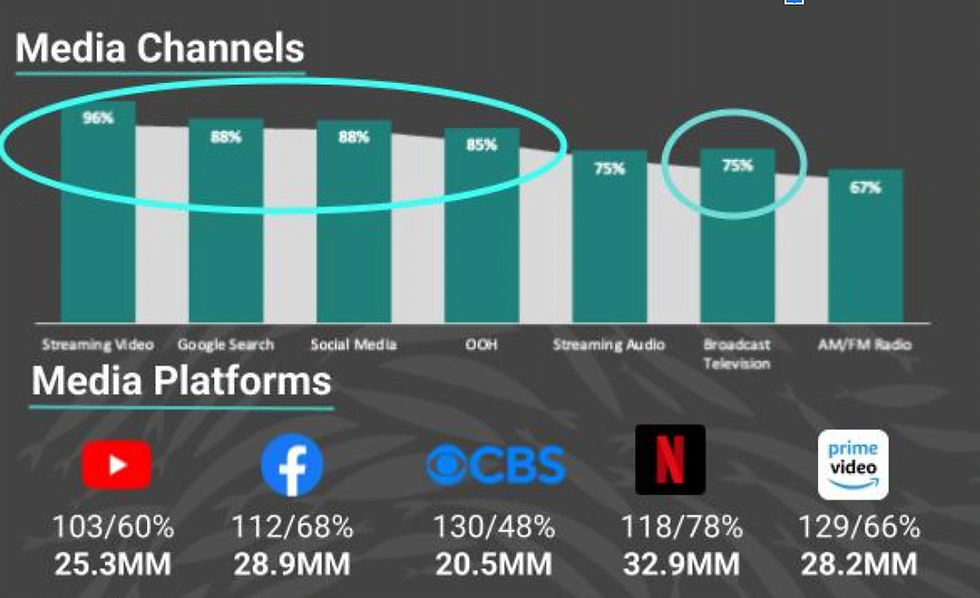
Media channel selection depends entirely on where your target audiences spend time and how they make purchase decisions. That said, several channels show particular strength heading into 2026:
Digital Advertising Channels
Retail media networks for driving sales, even for non-CPG brands
Connected TV (CTV) and Digital Audio for reaching broad audiences
Influencer / Creator partnerships for trust-building
Paid Search and Social for capturing high-intent demand
The way to differentiate from what all your competitors are already doing (especially if you don't have the budget to outspend them) is to think outside the box and build creative campaigns that stick in people's minds better than a digital ad.
Experiential Marketing Campaigns
Gen Z shoppers have been skipping digital ads since they were born. They grew up in a world where social media and technology are ubiquitous, making it harder for traditional advertisements to capture their attention. Experiential marketing is about creating immersive experiences that engage consumers on a deeper level.

Contests & Sweepstakes
Get your target audience engaged and excited, rather than passively consuming ads they likely won't recall later. Contests and sweepstakes with enticing incentives get people involved and emotionally invested in your brand more deeply than with your competition. Here's an example of an Adweek award-winning contest campaign we ran for former client Stella & Chewy's:

How do I prove media ROI to C-suite executives?
Connect media activities directly to business outcomes using clear attribution and incrementality testing. Report in business language (revenue, customer acquisition, market share) rather than marketing jargon (impressions, reach, engagement).
Show both short-term performance and long-term brand building impact. Use control groups and holdout testing to demonstrate causation, not just correlation. Be honest about measurement limitations and uncertainty rather than overstating confidence in attribution.
Is it cheaper to hire a media agency or buy media in-house?
The right model depends on your resources, expertise, and strategic priorities:
In-house teams offer greater control, brand intimacy, and agility.
Agencies provide specialized expertise, cross-client insights, and scalable capacity.
Many successful brands use a hybrid approach: in-house strategists and planners who set direction and manage performance, with agency partners providing specialized capabilities in areas like creative production, platform expertise, and advanced analytics. Learn more here.
How often should we revise our media plan?
Media strategies should be revisited quarterly at minimum, with major strategic reviews annually aligned to business planning cycles. Tactical optimizations happen continuously, with real-time adjustments daily or weekly and always-on refinements monthly.
The key is distinguishing between strategic pivots (which require careful consideration and cross-functional alignment) and tactical adjustments (which can happen quickly based on performance data). Don't confuse motion with progress by constantly changing strategy without giving tactics time to work.

What role does AI play in media planning?
AI excels at tactical optimization, pattern recognition, and processing large datasets. It can:
predict performance
personalize creative, and
identify audience segments at scales impossible for human teams.
But AI doesn't replace strategic thinking. Humans still need to set objectives, define brand positioning, understand market dynamics, and make judgment calls that require business context.
As a Brainlabs agency, we operate under a philosophy of Real Intelligence - the optimal blend of artificial and human intelligence that enables brands to connect directly with consumers.

Ready to build a full-funnel media strategy that delivers results? At Exverus by Brainlabs, we combine strategic planning, data-driven optimization, and cross-channel expertise to help brands navigate the complexity of modern media. Let's talk!
For more media buying tips, campaigns, and agency news; subscribe to our weekly Paid Media Insights newsletter here.


Comments