
CTV Media Buying for Growth-Stage Brands
Updated: Sep 18
A performance-minded guide to planning and measuring streaming TV ads on a midsized budget

Table of Contents
Key Takeaways
Direct response is the wrong CTV objective. CTV's real value shows up downstream—in branded search lift, paid social conversion rates, and assisted conversions—not in clicks. Measure it with MMM and brand lift studies, or don't run it yet.
CTV's budget floor is market-dependent, not absolute. Single-market testing can start at $10–15K/month on FAST channels; national campaigns need $75K+/month to register. Below your market's noise threshold, you're buying impressions that don't move the needle.
FAST channels aren't a compromise. 69% of CTV viewers prefer free ad-supported streaming, and growth brands often win on unit economics there. The right FAST vs. premium split depends on your audience, your creative, and your CAC target—not assumptions about quality.
Vanity metrics will get your CTV budget cut. Impressions, CPM, and completion rate don't tell finance anything useful. The metrics that keep CTV in the plan are branded search lift, site traffic lift, and cost per incremental action.

Intro
Connected TV (CTV) refers to internet-connected television sets and the digital content they stream. It's a powerful way to reach vast audiences with visually captivating advertisements.
EMARKETER projects CTV ad spend will surpass traditional TV by 2028, reaching $46.89 billion! And it's easy to see why: Brands love the broad scale CTV offers for building brand awareness and the cultural importance of the shows and movies they can align with.
However, streaming platforms are fragmented. This fragmentation makes targeting and measurement difficult. Attributing ad views to actual product sales can be a challenge. Add the generally higher cost of CTV inventory compared to social buys, and some growth-stage brands may wonder if the juice is really worth the squeeze.
We've mastered the art of hands-on campaign management for midsized brands like Premier Protein, New Belgium Brewing, and TV's "The Chosen." You can too, with this guide.

CTV budgeting for growth-stage brands
Brand marketers often ask, "What's the minimum budget needed to run an effective CTV media campaign?"
There's no one-size-fits-all answer. Your CTV budget floor depends on your geography and goals:
For single-market dominance or performance testing, $10-15K/month in smaller markets or on free ad-supported streaming TV (FAST) channels can work.
Mid-market brands in major DMAs might need $40-50K/month for meaningful share.
National brands need $75K+/month to register.
Below your market's 'noise threshold,' you're buying impressions that don't register. The more important questions to ask yourself are:
What specific objectives am I trying to accomplish?
What would success actually look like?
Where are your target consumers located?
What channels or content do they enjoy watching?

The Halo Effect: How CTV drives downstream growth
Many growing brands chase direct response on CTV. They run a spot, watch for immediate conversions, see nothing, and cut the budget. That's actually backwards and wastes money.
Per The Hollywood Reporter, TV's share of global ad revenue is declining from 15.8% in 2024 to a projected 13.9% in 2026. Advertiser budgets are moving toward more performance-driven digital channels. A lot of that budget migration comes down to measurement confidence.
Performance channels give marketers a dashboard full of precise numbers. In contrast, TV gives them fragmented reach and visibility. The math seems easy: follow the metrics. But one channel's dashboard doesn't show the whole story.
If you measure only CTV-direct conversions, you'll miss 60–70% of the incremental value. A campaign that looks "inefficient" on CTV alone often shows 3–5x return when you connect it to downstream channel lift and cross-device journeys.

How to set up a halo funnel:
Use MMM to connect your TV investment to downstream outcomes. TV's cross-channel effects—lifted search volume and improved paid social conversion rates—don't show up in a standard dashboard. Marketing mix modeling is how you find them before someone cuts the budget.
Run a brand lift study and tie it to mid-funnel signals. The more you invest in brand, the lower your customer acquisition cost should trend over time—but you need the data to prove it. Pairing a brand lift study with CAC tracking is how TV gets a seat at the performance table.
Start testing shoppable CTV formats. Upper-funnel doesn't have to mean unmeasurable. Shoppable CTV ads incorporate interactive or transactional features directly into television platforms. This gives you conversion data alongside reach. Brands testing it today will have a meaningful head start as the format matures.
If you're running CTV without MMM, brand lift studies, or multi-touch attribution, you're flying blind. Better to wait until you have the measurement budget than to run a campaign you can't defend.

The FAST vs. Premium CTV tradeoff for brands
Many assume that premium CTV networks like Netflix, Hulu, and Disney+ are automatically superior to FAST channels like Tubi or Pluto. But that's not necessarily true.
In reality, 69% of CTV viewers prefer FAST channels. Challenger brands can take advantage of their lower barrier to entry. (The Trade Desk provides unified buying and targeting across both!)
Let's compare the pros and cons:
Where FAST wins the race | How Premium takes the cake |
|---|---|
Lower CPMs ($15-30 vs. $25-60) | Targeting affluent, younger audiences |
Less programmatic competition | New product launches (premium context = high brand perception, safety) |
More frequency for same budget = better brand lift | May convert more often than FAST = lower CAC |
Shorter, punchier creative (15-30sec) & lower frequency | Longer ad formats, higher completion rates |
Avoiding fraud & protecting brand safety
Some brand marketers worry about fraud in the programmatic advertising supply chain or their ads showing up next to harmful content. That's understandable! But our expert traders have mastered brand safety, data privacy, and waste prevention. Here's how:
Platform defenses
Tier 1 (Hulu, Disney+, Netflix, Roku, etc.) have strong safeguards (first-party content, curated supply).
Tier 2 (Pluto TV, Tubi, Samsung TV+, etc.) have moderate safeguards (some UGC content, but editorial review).
Tier 3 Open marketplace (via SSPs like PubMatic) has lower safeguards (all publishers welcome).
For growth-stage brands, we recommend sticking to tier-1 and tier-2 platforms unless the budget is very small.
Also, The Trade Desk integrates pre-bid fraud detection (ads.txt enforcement, Supply Path Optimization) and partners with third-party verification vendors IAS and DoubleVerify. This gives human traders full placement transparency, not a black-box algorithm.
Agency defenses
We don't leave programmatic trading up to managed services. Our in-house trading experts personally oversee every transaction and negotiate the best rates for our clients.
To that end, we create publisher inclusion and exclusion lists in DoubleVerify that supersede any automated content partners. We continuously monitor ad placements for factors like viewability, fraud, contextual relevance, and quality of environment.

"Brand safety isn't a filter you bolt onto programmatic after the fact — it's a function of how precisely you understand the inventory you're buying. The more contextual signal and show-level data a brand can get before the impression hits the bid stream, the more confidently they can show up next to content that actually reflects who they are — and stay out of content that doesn't."
SEAN EDWARDS, Director of Programmatic & E-Commerce Media
CTV Reporting That Matters
Don't get caught up in vanity metrics like impressions and CPMs—they mean nothing if those views don't translate to actual sales or brand growth down the road! Growth-stage brands don't have the budget to waste optimizing toward the wrong KPIs.
Vanity Metrics | Meaningful Metrics |
|---|---|
Impressions (not predictive) | Branded search lift (2-4 weeks after exposure) |
CPM (doesn't mean better CAC) | Site traffic lift (from GA4, attributed to CTV exposure cross-device) |
Reach (raw number is meaningless without frequency & attribution) | Completion rate (global benchmark 95% or higher) |
Shopping cart additions | Cost per incremental action (from incrementality test) |

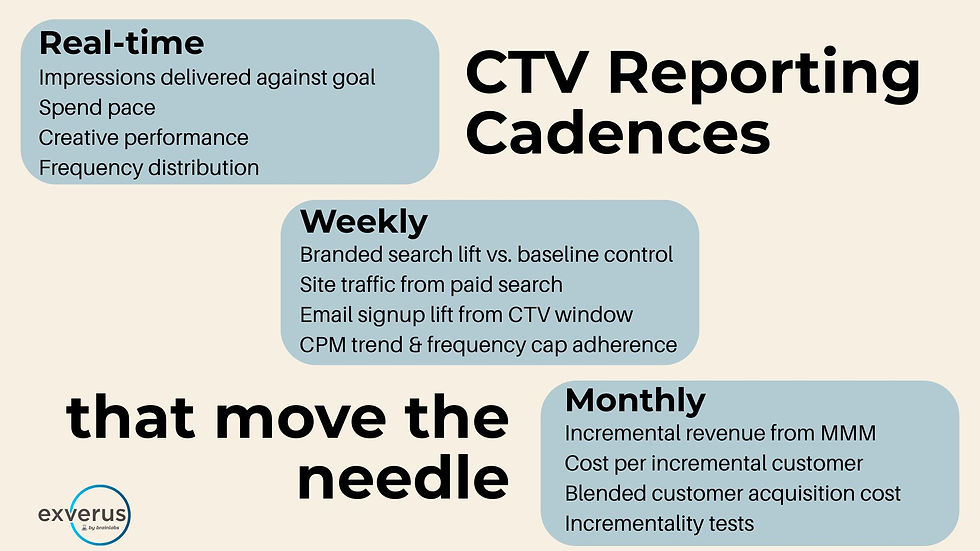
And the scheduling or cadence of your reporting matters too. Since CTV is largely a top-of-funnel brand-building tactic, you might see very real effects later down the road.
If you're too quick to evaluate and change your strategies after just a week or a month, you may be cutting the very things keeping your brand moving up and to the right over time.
Here's a better timeline for reporting, which you can modify to your specific campaign objectives and parameters:
Try Shoppable CTV for Performance
Shoppable CTV, or T-commerce, is a hugely popular ad format for its ability to collapse the path between entertainment and purchase into a single tap. It incorporates interactive elements into TV ads like QR codes, "Add to Cart" buttons, or "Email me this" links that viewers can use with their remote control or smartphone.
These campaigns can be very effective—but not always for the reason you think. Exverus' Media Supervisor Melanie Mogey ran a shoppable CTV test for TV's "The Chosen" and explained to Digiday that direct sales were not the primary KPI—video completion rate (VCR) was.
In other words, Mogey and other media buyers have found that this kind of play isn't always a converter, but rather a strong awareness-builder. That's an outcome well worth striving for, but it does require different planning and measurement.

CTV works for growth-stage brands when it's planned honestly: right budget for your market, right measurement infrastructure, right mix of FAST and premium inventory. The brands that win aren't the ones with the biggest budgets—they're the ones who know exactly what they're measuring and why. If you're ready to build a CTV strategy that connects to real business outcomes, let's talk.
For more media buying tips, campaigns, and agency news; subscribe to our weekly Paid Media Insights newsletter here.
AI Disclosure: We use AI models to quickly consolidate information from top industry sources and combine it with our real-world expertise. Every word drafted is carefully reviewed, edited, and confirmed by human eyes and hands for accuracy and quality. All information on exverus.com has been executive-approved and is updated daily.


