
Customer Retention Strategies in Paid Media
- Jul 15
- 3 min read
When it comes to loyalty, think long-term, not last-click

Many brand marketers still draw a hard line between acquisition and retention media. Paid channels find new customers, then email and CRM keep them hooked. But that line is disappearing.
Retail media: The overlooked loyalty channel
Retail media networks (RMNs) have loyalty infrastructure already built in: Amazon's Brand Tailored Promotions, Walmart Connect's shopper segments, paid social suppression and sequencing, and programmatic retargeting all let you treat existing customers differently from prospects, inside the same media buy you're already running.
And Walmart’s recent restructuring, which aligns Walmart Connect with Sam’s Club Connect for shared capabilities, champions the membership model as a persistent, relationship-based view of customers rather than a series of one-off transactions.
It means retailers can now see not only what a customer bought, but what ads they were exposed to, how they engaged, what they did next, and how their patterns emerge over time. These first-party data points form the foundation for repeat purchases and lifetime value, not just campaign-level ROAS.
That’s golden for brands, as RMNs are quietly becoming loyalty engines informing long-term brand equity, not just immediate performance. If your team is still treating every impression as a single-touch acquisition moment, you’re paying for infrastructure you’re not using.

How can I build customer loyalty using retail media networks?
Perform customer analysis to determine the cost and value of acquiring a new-to-brand customer versus the cost and value of retaining brand loyalists.
Identify which paid media channels in your current mix are being used exclusively for acquisition — and map out where retention audiences could be activated instead.
Apply a framework for sequencing paid media touchpoints to existing customers based on purchase history and lifetime value tier, rather than treating all retargeting as a single undifferentiated pool.
Evaluate retail media networks' closed-loop measurement capabilities to determine if they're leaving retention-focused media spend on the table.

Media mix modeling (MMM) as loyalty engine
Most teams treat media mix modeling (MMM) as a rearview mirror: run the campaign, wait for the quarter to close, then let the model tell you what worked.
But EMARKETER's Media Mix Modeling Trends 2026 report (to which Exverus's own VP of Analytics Joshua Edelman contributed) confirms that gap is now the industry's biggest measurement constraint.
MMM is evolving from a reporting tool into a decision engine, but most marketers aren't ready for that shift. Only 28% of marketers say their organization is very effective at converting MMM insights into action! That's likely because they’re thinking of MMM after a campaign, rather than before.
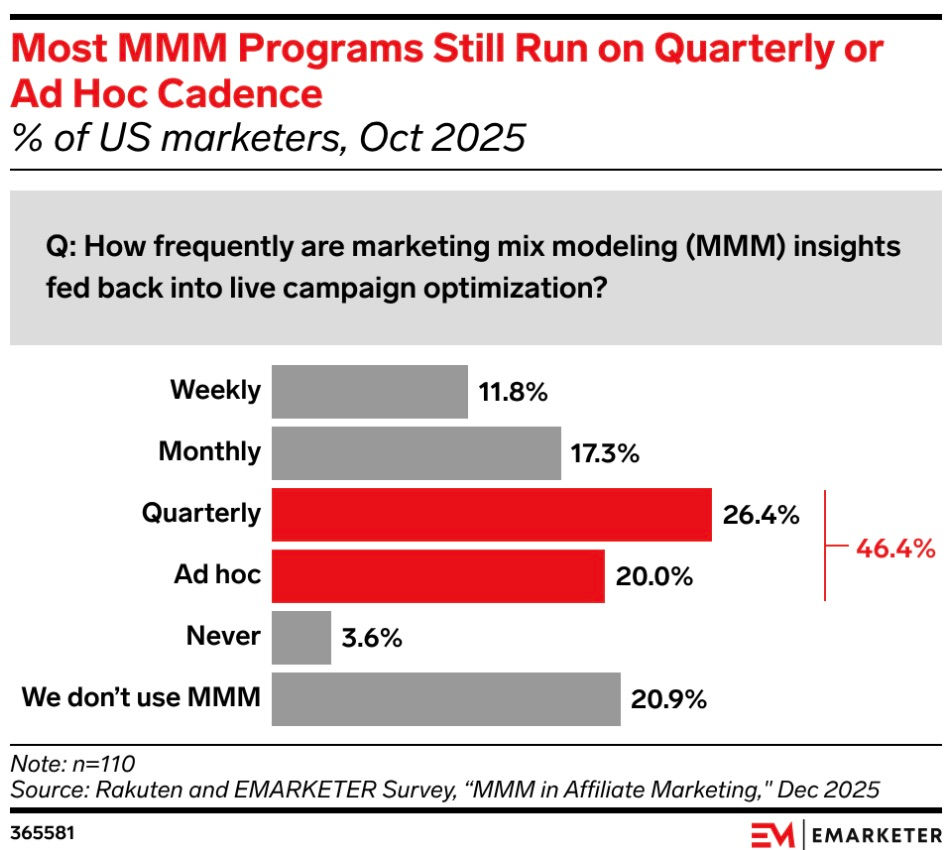
The mismatch shows up hardest in customer loyalty and retention. Acquisition spend gets modeled aggressively because the feedback loop is fast. Retention rarely gets the same treatment — the payback is slower, the attribution murkier — so it gets planned by instinct, or worse, left out of the model entirely until someone asks why churn spiked after a tentpole event.
That's backwards. As EMARKETER reports, the optimal modeling cadence depends on the decision being made, which means if retention is a KPI you’re seeking in Q4, it needs to be in the model before Q4, not reconstructed from Q3's numbers after the fact.
Before you build your holiday retention budget, model it. Before you brief your loyalty program refresh, size it against your other channels in the same tool you'd use to defend a paid social increase. MMM done right doesn't just tell you retention worked — it tells you how much to put behind it before you needed it to.

How do I model customer retention strategies in MMM?
Add retention/loyalty as a standing line item in your MMM inputs now, ahead of Q4 planning — not as a post-hoc addition.
Set your modeling cadence to match your decision calendar: quarterly retention decisions need quarterly-relevant model inputs, not just annual reporting.
Require a documented expected payback for loyalty spend the same way you would for any acquisition channel — no more "soft" budget lines.
For more media buying tips, campaigns, and agency news; subscribe to our weekly Paid Media Insights newsletter here.


Comments